

Don’t neglect your spiritual reading. Reading has made many saints.”
St. Josemaría Escrivá
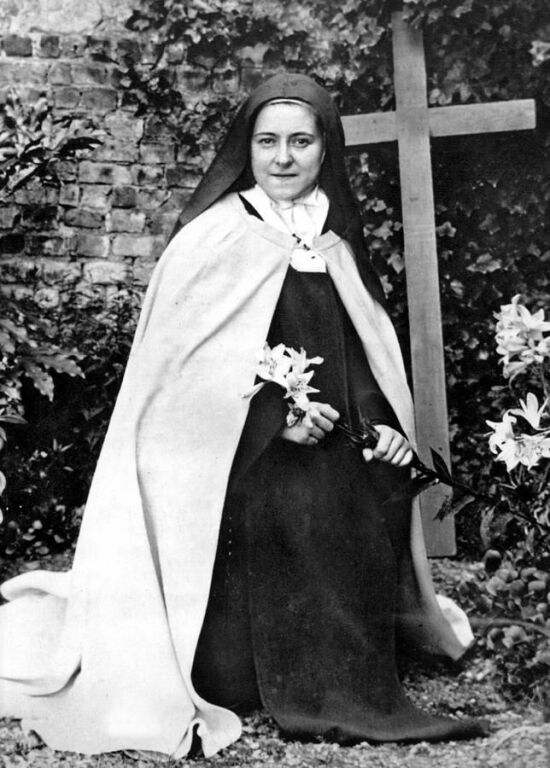
When Thérèse was 17, she confided to a visiting Jesuit her hope of becoming a great saint and to love God as much as the Carmelite Saint Teresa of Ávila. The Jesuit thought he found traces of pride and presumption and advised her to moderate her desires. “Why, Father?” asked Thérèse, “since our Lord has said, Be perfect as your heavenly Father is perfect.” 100 years after Thérèse’s death, Pope John Paul II declared her a Doctor of the Church, joining St Catherine of Siena and St Teresa of Ávila.

Credit: Universalis
In the heart of the church I will be love
From the autobiography of St Thérèse of Lisieux
Since my longing for martyrdom was powerful and unsettling, I turned to the epistles of St Paul in the hope of finally finding an answer. By chance the 12th and 13th chapters of the 1st epistle to the Corinthians caught my attention, and in the first section I read that not everyone can be an apostle, prophet or teacher, that the Church is composed of a variety of members, and that the eye cannot be the hand. Even with such an answer revealed before me, I was not satisfied and did not find peace.
I persevered in the reading and did not let my mind wander until I found this encouraging theme: Set your desires on the greater gifts. And I will show you the way which surpasses all others. For the Apostle insists that the greater gifts are nothing at all without love and that this same love is surely the best path leading directly to God. At length I had found peace of mind.
When I had looked upon the mystical body of the Church, I recognised myself in none of the members which St Paul described, and what is more, I desired to distinguish myself more favourably within the whole body. Love appeared to me to be the hinge for my vocation. Indeed I knew that the Church had a body composed of various members, but in this body the necessary and more noble member was not lacking; I knew that the Church had a heart and that such a heart appeared to be aflame with love. I knew that one love drove the members of the Church to action, that if this love were extinguished, the apostles would have proclaimed the Gospel no longer, the martyrs would have shed their blood no more. I saw and realised that love sets off the bounds of all vocations, that love is everything, that this same love embraces every time and every place. In one word, that love is everlasting.
Then, nearly ecstatic with the supreme joy in my soul, I proclaimed: O Jesus, my love, at last I have found my calling: my call is love. Certainly I have found my place in the Church, and you gave me that very place, my God. In the heart of the Church, my mother, I will be love, and thus I will be all things, as my desire finds its direction.
Credit: Divine Office: Office of Readings; 01 Oct, Feast of St Thérèse of Lisieux; https://divineoffice.org/welcome/

Information herein posted under the "rules of fair use" to foster education and discussion in accordance with Section 107 of the Copyright Act 1976.
How can I fear a God who is nothing but mercy and love.”
Saint Thérèse of Lisieux
My little way is the way of spiritual childhood, the way of trust and absolute self-surrender.”
Saint Thérèse of Lisieux
“From ancient times the Church has had the custom of celebrating each day the liturgy of the hours. In this way the Church fulfills the Lord’s precept to pray without ceasing, at once offering its praise to God the Father and interceding for the salvation of the world.” — Office of the Sacred Congregation for Divine Worship.

The Liturgy of the Hours is the prayer of the whole People of God. In it, Christ himself “continues his priestly work through his Church.” His members participate according to their own place in the Church and the circumstances of their lives. The laity, too, are encouraged to recite the divine office either with the priests, among themselves, or individually.

The celebration of the Liturgy of the Hours demands not only harmonizing the voice with the praying heart, but also a deeper “understanding of the liturgy and of the Bible, especially of the Psalms.”

The hymns and litanies of the Liturgy of the Hours integrate the prayer of the psalms into the age of the Church, expressing the symbolism of the time of day, the liturgical season, or the feast being celebrated.

Credit: https://divineoffice.org/liturgy-of-the-hours/
Half an hour’s meditation each day is essential, except when you are busy. Then a full hour is needed.”
Saint Francis de Sales

Rejoice always. Pray without ceasing. In all circumstances give thanks, for this is the will of God for you in Christ Jesus.”
1 Thessalonians 5:16-18

Holy Spirit, Light and Life of my Soul, enliven my prayer life.
Be not afraid! And may the peace of Christ be with you and your loved ones today and always. Holy Family, pray for us. Amen.


